
"colonial agriculture"
600 article(s) found

Mexican Coffee Story Mexican Coffee Plantation Recommended: Oaxaca
Professional coffee knowledge exchange More coffee bean information Please pay attention to coffee workshop (Weixin Official Accounts cafe_style) North latitude and climate can not grow coffee, coffee planting areas are in the south. Ninety percent of Mexico's coffee comes from four southern provinces: Chiapas (35 percent), Oaxaca (13 percent), Puebla (15 percent) and Veracruz (25 percent). There are nearly 50 in the country

El Salvador Coffee Features Flavor Taste Estate Production Area Introduction Mercedes Estate
Salvador has a large number of buildings from the sixteenth century and religious buildings, many of which are decorated with sculptures from the seventeenth and eighteenth centuries, and many of which are striped with colored clay, reflecting the characteristics of the colonial period. Its overall character is described by a forest of monuments and a consistent vision. All of this suggests that El Salvador is a city structured for colonization.

Flavor description of Guatemalan Coffee with strong and other characteristics introduction to the taste of high-quality coffee beans in the producing area
The Guatemalan Coffee Research Institute is a coffee institution run by the producers themselves, and it is also the main coffee-related institution in Guatemala. It is not only responsible for diversified undertakings such as coffee-related agricultural counseling, but also responsible for compiling a resume guide for local coffee production and the harvest time in the lowlands is also different. Coffee trees in the lowlands bloom from January to March, and the harvest period begins around September. Highland

Introduction of Salvadoran Coffee Variety and Flavor description characteristics of producing area introduction of high-quality coffee beans
The city of El Salvador has a large number of 16th-century buildings and religious buildings, many of which are decorated with 17th-and 18th-century carvings and stripes made of colored mud, reflecting the characteristics of the colonial period. Its overall characteristics are described through a forest of monuments and consistent ideas. All this shows that El Salvador is a city with a suitable structure for the colony.

Introduction to boutique coffee from Dominica with winding aftertaste and smooth taste.
Thousands of Tylenos were demoted to slavery and engaged in gold mining. Due to a series of oppression, hunger and disease, by 1535, the Tino had only 60,000 left. In 1501, King Ferdinand I and Isabella of Spain were the first to allow Caribbean colonists to introduce slaves from Africa. They began to arrive on the island in 1503. [3] in the early days of the Spanish island, the Spaniards were in the new.

The origin of coffee beans in Rwanda Coffee bean powder is too weak.
The Rwandans of origin have been growing coffee since colonial times, but until 1999, its products were still classified as below Class C and were not popular in the global market. The reason for the poor quality is that farmers do not have a fixed procedure for washing coffee beans and do not process coffee fruits according to specifications in time. Buyers buy coffee beans at $0.33 per kilogram, and farmers rely on the meagre profits earned at low prices.

The long aftertaste of Rwanda's Chimaier estate fine coffee beans variety planting market price profile
PEARL brought coffee specialists to Rwanda, where it was responsible for maintaining contact with the seller, Community Coffee of Louisiana, USA, and sending samples to Louisiana. In June 2002, representatives of Public Coffee visited Malabar. At that time, the current President of Rwanda, Paul Kagame, spoke on behalf of the government about the importance of this plan.
Characteristics of coffee beans in Rwanda planting methods of coffee beans in Rwanda
Rwandans have been growing coffee since colonial times, but until 1999, its products were still classified as below Class C and were not popular in the global market. The reason for the poor quality is that farmers do not have a fixed procedure for washing coffee beans and do not process coffee fruits according to specifications in time. Buyers buy coffee beans at $0.33 per kilogram, and farmers keep warm by the meagre profits earned at low prices.

A brief introduction to the history and culture of the origin and development of Dominican boutique coffee
Boutique coffee has become popular in recent years. High-quality coffee beans produced by some Dominican estates have a rich aroma, mellow taste and moderately bright sour taste, which are not far from the more famous Puerto Rico beans or Jamaican beans, and are also worth tasting. Dominica coffee beans have moderate acidity and rich fruit flavor. Western Hispaniola, 1500 m above sea level

Historical Brand Price and Flavor description of Coffee grown in Vietnam
Historical Brand Price and Flavor description of Coffee grown in Vietnam Nhan has been working hard on the dream of reuniting North and South Vietnam since he was a student. In 1964, the year before the Battle of Xisheng, Nhan received a scholarship for a master's degree in soil science in southern China. Nhan graduated in 1967 and then returned to Vietnam to start PhuQuy in Nghe.

What is the best brand of tea in the top ten tea producing countries in the world? what is the history and culture of tea in each country?
The annual consumption of tea exceeds 3 million tons, making it the second most popular drink after water. It can be said that it occupies an important position in culture and economy. As a drink, it has many different cultures. As a kind of agricultural product, tea industry is an important economic factor in its producing area. The best tea producing area in the world [China] ranks first in tea production in the world.

Dominica Santo Domingo Coffee with rich flavor description, grinding degree, taste, fine coffee.
In 1677, about 4,000 French lived in 11 villages in the west of the island. In 1697, France and Spain ceded the western part of the island to France according to the Leswick Treaty of the Alliance War, formally recognizing French sovereignty over Haiti in the western part of the Spanish island, and the eastern part of the Spanish island was called East Santo Domingo. France continues to develop its agricultural economy on the island of Hispaniola.

A brief introduction to the export volume of coffee bean planting area in the Fire Phoenix Manor of Costa Rica in North America.
A detailed introduction to the output and export area of coffee beans planted in Costa Rica Fenghuang Manor in North America in 1563, Costa Rica became a Spanish colony and came under the jurisdiction of the Governor of Guatemala. During the colonial period, under the cruel enslavement and oppression of the Spanish colonists, the Indians were almost wiped out, and there was little labor available for enslavement, and the Spaniards were forbidden.

Jamaica Coffee Practice Jamaica Coffee Origin Jamaica Coffee What is the taste
Professional coffee knowledge exchange More coffee bean information Please pay attention to coffee workshop (Weixin Official Accounts cafe_style) The history of Jamaica coffee actually began in France. King Louis XIV of France was interested in promoting coffee in the colonies with the aim of creating a French-controlled coffee source. He got a live plant from the Dutch and planted it in the botanical gardens of Paris.

A preliminary study on the Origin, Development, spread and Beverage Culture of Coffee
Coffee, tea and cocoa are the three major beverages in the world, which are consumed by about LM people all over the world, and their consumption is second only to drinking coffee in Europe and the United States. Coffee consumption is also becoming more and more popular in China and other eastern countries. However, in Chinese academic circles, there are no papers and monographs on coffee from the perspective of agricultural history and custom history.

Faintly fruity Dominica Santo Domingo Coffee Flavor Manor
At the beginning of the 17th century, when French, Dutch and British pirates were operating in the west of Hispaniola, France began to allow farmers and merchants to gradually colonize the western part of the Spanish island, which was blocked by mountains on the island. It didn't attract the attention of the Spaniards in the east. [3] in 1677, about 4,000 French lived in 11 villages in the west of the island. In 1697, France and

An introduction to the characteristics of fine coffee beans in the manor area
After the first World War, the long-standing dissatisfaction of the Ugandan people with colonial rule finally broke out. A national general strike and rural riots broke out in 1918. In 1919 Buganda launched a democratic movement under the leadership of the Bataka Party and the African Farmers' Union of Uganda. In 1921, Uganda's first national political party, the Ugandan National Congress Party, was established and proposed the implementation of universal suffrage.
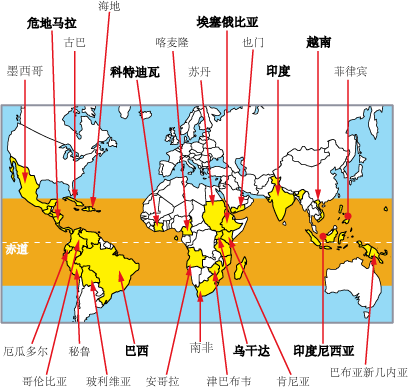
Vietnamese coffee is characterized by Japanese investment in Vietnamese coffee and French flavor.
Vietnam is a big producer today and a giant of tomorrow. Perhaps under the influence of French colonial rule, coffee grown in Vietnam has a French flavor. Arabica coffee was first brought to Vietnam by French missionaries. More than 400,000 coffee trees were introduced to Vietnam from 1865 to 1876 and were planted near Tonkin Bay, mostly Java or bourbon varieties. At present, the output of coffee in Vietnam is

Rwanda Coffee Flavor and Taste introduction Rwanda Fine Coffee beans Rwanda Coffee characteristic Manor
Rwanda's economy is dominated by agriculture. The population engaged in agriculture and animal husbandry accounts for 92% of the country's population. The main cash crops are coffee, tea and cotton. Because it is an agricultural and animal husbandry country, coupled with the loss of many young workers caused by the genocide in 1994, it is a huge blow to a country that is not already rich, and Rwanda is still a backward country. Luwang after the Civil War

El Himalayan Coffee Grind Characteristics Variety Flavor Description Taste Introduction
San Salvador, Bahia. An important natural deep-water port on Brazil's Atlantic coast, capital of Bahia. Located on the east coast of the Bay of Todos (Santos). With a population of 3,459,377 (as of August 1, 2010), it is the eighth largest city in Brazil. It is one of the oldest cities in Brazil, founded in 1549, and the first churches were built by Jesuit priests in 1549. until 1763.